Everyone slows down. Some people slow down faster than others.
ONKI shows older adults how their own typing rhythm is changing, relative to their peers. It makes no diagnosis and sets no threshold. We are testing whether that alone is enough to prompt someone to go for screening.
Why this study
Keyboard on. Memory on. Onki (온기) means warmth in Korean — the kind a neighbour once offered by noticing something and saying so.
Korea already has the infrastructure. Community dementia centres are in place and CIST — the national cognitive screening test — is free. Participation among older adults is still low.
The barrier is not access or cost. What is missing is the prompt: the moment someone thinks, maybe I should go and get checked.
Before treatment comes diagnosis. Before diagnosis comes screening. And before either, awareness. ONKI works only at that very first step.
- 01 Awareness — ONKI stops here
- 02 Screening — free CIST, at district dementia-safety centres
- 03 Diagnosis — where most detection research sits
- 04 Treatment
Steps 02 to 04 are someone else's work, and they already exist. The widest, cheapest step is the first one, and it is where people fall away. ONKI collects keystroke timing passively during ordinary phone use, and shows a person how their own rate of change compares with others in their age group. No risk score, no classification, no recommendation — the inference is left entirely to the individual.
The comparison logic is borrowed from audit: not an absolute threshold, but a deviation from what was expected of this particular case.
BISHAC 2026, Singapore
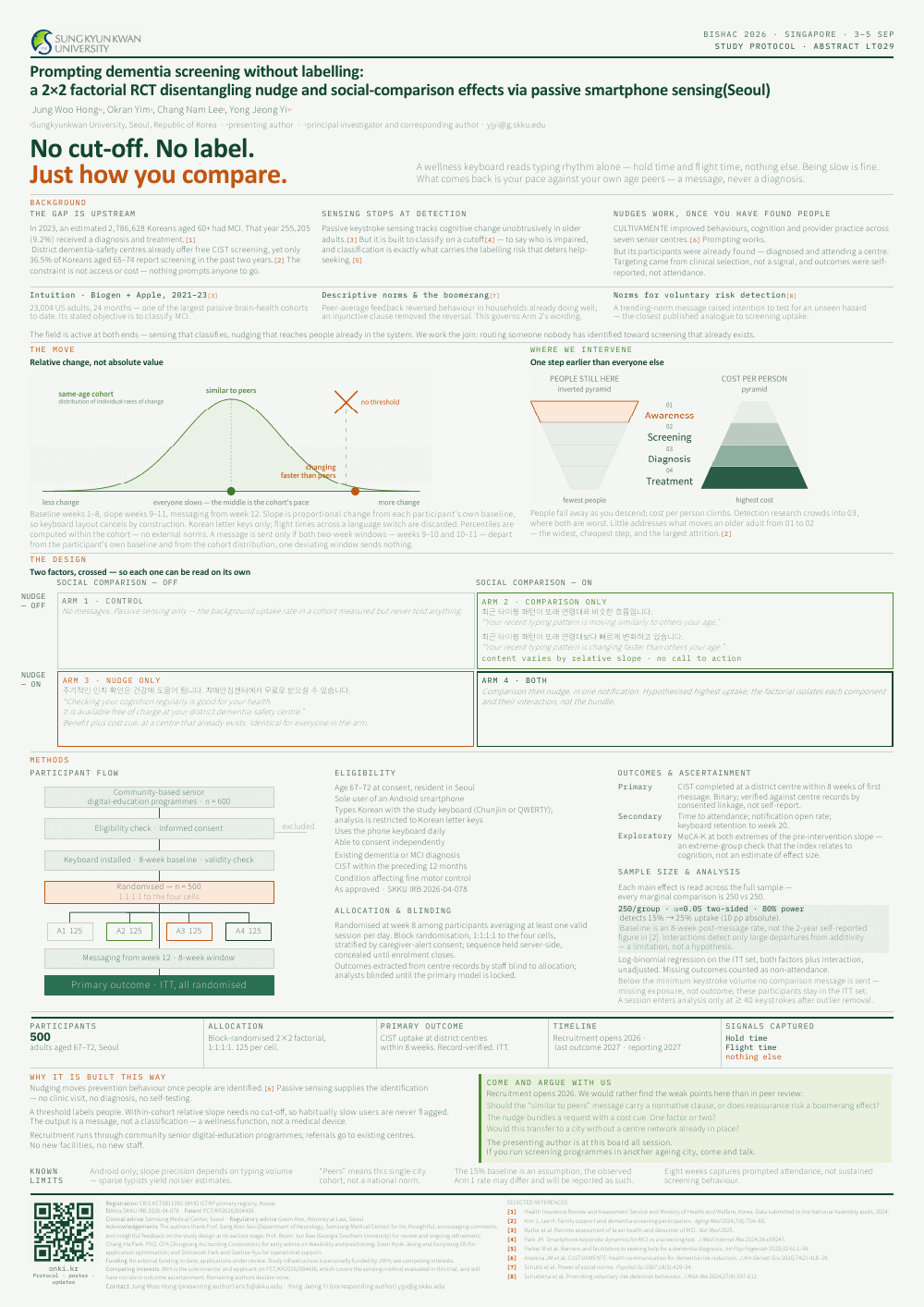
Prompting dementia screening without labelling: a 2×2 factorial RCT disentangling nudge and social-comparison effects via passive smartphone sensing (Seoul)
Jung Woo Hong (presenting author), Okran Yim, Chang Nam Lee, Yong Jeong Yi (principal investigator)
Background. Before treatment comes diagnosis, before diagnosis screening, and before either, awareness. In super-aged Seoul, dementia screening reaches only a fraction of older adults, and most early mild cognitive impairment (about 28% prevalence) goes undetected. A recent cluster-RCT showed nudges improved dementia-prevention behaviours (Aravena et al., JAGS 2026), but delivered them non-specifically; targeting whom to prompt remains unaddressed, and daily-test designs lose the highest-risk elderly to attrition. Crucially, the intervention neither diagnoses nor screens: absolute typing speed is irrelevant, being inherently slow is fine, and only those slowing faster than their age peers are gently prompted. The aim is motivational, not diagnostic.
Methods. Stratified, block-randomised 2×2 factorial RCT crossing a screening nudge with peer-referenced social comparison; 500 adults aged 67 to 72, stratified by caregiver-alert consent. A wellness keyboard passively records typing timing only (hold time, flight time). Unlike large device-based detection studies pursuing classification, the endpoint is screening behaviour: the model detects within-cohort relative deceleration versus same-age peers, so habitually slow users are never labelled. Recruitment runs through municipal senior digital-education programmes; referrals go to district dementia-safety centres, layering onto existing infrastructure without new facilities. Primary outcome: screening uptake (CIST, intention-to-treat); exploratory secondary: cognitive-test (MoCA-K) enrichment in the top passive-index group.
Anticipated results. We hypothesise the combined nudge-plus-comparison arm yields the highest uptake, the design isolating each component and their interaction. IRB-approved (SKKU 2026-04-078); prospectively registered (CRIS, a WHO ICTRP Primary Registry, Korea; KCT0011992); recruitment from 2026.
Conclusion. If effective, this offers a non-stigmatising, infrastructure-light model to raise screening uptake: digital neighbourly care reconnecting isolated elders to peers and public services, transferable across ageing Asian cities.
Relevance. It applies behavioural science (nudging, social comparison) to a high-burden screening behaviour and tests an implementation strategy: a fully passive design embedded in existing infrastructure for equitable reach, addressing the know–do gap.
Abstract to appear in an Implementation Science supplement.
Conflict of interest. The presenting author holds the patent on the tool under study (KR 10-2025-0049943; PCT/KR2026/004436), declared in the IRB submission and the trial registration.
- Design
- 2×2 factorial randomised controlled trial (nudge × social comparison)
- Participants
- 500 community-dwelling adults aged 67–72, Seoul
- Measure
- Keystroke timing (hold time, flight time), collected passively
- Primary outcome
- CIST uptake, confirmed through administrative records
- Ethics
- SKKU IRB 2026-04-078
- Registration
- CRIS KCT0011992
- Patent
- PCT/KR2026/004436
Where the trial stands
Protocol approved and registered. Recruitment has not yet begun.
This is the earliest stage of the project. No participant has been enrolled, and there are no results — what exists is a protocol, made public before enrolment locks it. The app has been brought in-house, the collection pipeline rebuilt for timing data only, and the analysis plan is being finalised. That is also why the poster asks for objections rather than reporting findings. Updates will be posted here.
The study team
- Principal investigator
- Yong Jeong YiAssociate Professor, Department of MetaBioHealth, Sungkyunkwan University
- Presenting author
- Jung Woo HongSungkyunkwan University
- Co-investigators
- Okran YimPhD candidate, Sungkyunkwan University
- Chang Nam LeePhD candidate, Sungkyunkwan University
Clinical advice from Samsung Medical Center, Seoul. Further academic and clinical collaborators will be listed as the trial proceeds.
Who runs this
- Jung Woo Hong
- Study design, regulatory filings, operations
- Shinwook Park
- Research collaboration
- Daehee Ryu
- Operations and funding
Study investigators are listed above. This section covers the people who build and run the tool.
Questions, objections, or “have you considered…”
We would rather find the weak points now than after enrolment locks the protocol. If you run screening programmes in another ageing city, or you think the design is wrong somewhere, please write.
- Study
- jungwoo@onki.krJung Woo Hong — study design and operations
- Academic
- erich@skku.eduJung Woo Hong — Sungkyunkwan University; the address on the poster and the abstract
- Collaboration
- wookshin@onki.krShinwook Park — research collaboration